
1. Introduction to ASHRAE 90.1-2022 (I-P)
The ASHRAE 90.1-2022 (I-P) Standard serves as a foundational benchmark for energy-efficient design in commercial buildings across the United States and influences global standards. This document provides the minimum requirements for energy-efficient design of most sites and buildings, with the specific exclusion of low-rise residential buildings. It details criteria for the design and construction of new sites, buildings, and their systems, as well as modifications to existing structures and their components.
This standard is an indispensable reference for engineers, architects, building owners, and other professionals involved in the design, construction, and operation of buildings and their associated systems. Adherence to this standard ensures compliance with energy efficiency regulations and promotes sustainable building practices.
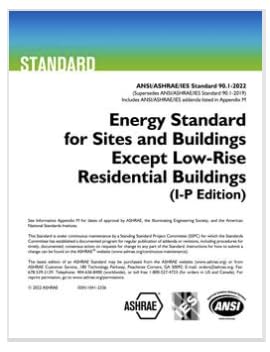
Figure 1: Cover of the ASHRAE 90.1-2022 (I-P) Standard document. This image displays the title "Energy Standard for Sites and Buildings Except Low-Rise Residential Buildings (I-P Edition)" along with the ASHRAE and ANSI logos.
2. Scope and Application of the Standard
2.1. Cymhwysedd
Standard 90.1-2022 applies to:
- New sites and buildings.
- New portions of buildings and their systems.
- New systems and equipment in existing buildings.
It provides minimum energy efficiency requirements for the design and construction phases, as well as criteria for determining compliance.
2.2. Gwaharddiadau
This standard specifically excludes low-rise residential buildings from its scope. Users should consult other relevant ASHRAE standards or local building codes for such structures.
3. Using the Standard: Key Requirements and Paths
3.1. General Application
To effectively use ASHRAE 90.1-2022, users should familiarize themselves with its structure, which typically includes sections on Administration and Enforcement, Definitions, Building Envelope, HVAC, Service Water Heating, Power, Lighting, Other Equipment, and Energy Cost Budget Method.
3.2. Major Additions in 2022 Edition
The 2022 edition incorporates over 80 addenda from the 2019 edition, introducing several significant changes:
- On-Site Renewable Energy: A new minimum prescriptive requirement for on-site renewable energy generation.
- Mechanical System Performance Path: An optional path allowing HVAC system efficiency tradeoffs based on the new Total System Performance Ratio (TSPR) metric.
- Thermal Bridging: New requirements to address the impacts of thermal bridging in building envelopes.
- Expanded Scope: The scope now explicitly includes sites in addition to buildings.
- Energy Credit Requirements: New requirements for a customized approach to improving energy efficiency.
- Alternative Performance Metrics: Informative guidance for using carbon emissions, site energy, or source energy as alternatives to the energy cost metric.
- Efficiency Increases: Significant increases in IEER for commercial rooftops and a new SEER2/HSPF2 metric for air-cooled heat pumps under 65K BTU/h.
Users are advised to review the specific sections pertaining to their project type and design considerations.
4. Staying Updated: Addenda and Revisions
ASHRAE standards are periodically updated to reflect advancements in technology and best practices. The 90.1-2022 edition itself is a result of numerous addenda to the 2019 edition. Users should regularly check the official ASHRAE website for any new addenda or interpretations that may affect the application of this standard.
Addenda are typically published between full editions and provide clarifications, corrections, or updates to specific clauses. Incorporating these addenda is crucial for maintaining compliance and utilizing the most current energy efficiency practices.
For official updates and errata, please visit the ASHRAE websafle.
5. Common Questions and Troubleshooting
5.1. Interpreting Requirements
If a specific requirement seems unclear, refer to the definitions section within the standard. Additionally, ASHRAE often publishes interpretations of its standards, which can be found on their website. Consulting with experienced professionals or ASHRAE technical committees can also provide clarity.
5.2. Compliance Challenges
When facing challenges in meeting specific prescriptive requirements, explore the alternative compliance paths offered by the standard, such as the Energy Cost Budget Method or the new Mechanical System Performance Path (TSPR). These paths allow for greater design flexibility while still achieving the required energy performance.
5.3. Locating Information
The standard is organized into logical sections. Use the table of contents (within the physical document) and index to quickly navigate to relevant chapters and clauses. Pay close attention to footnotes and appendices, which often contain critical supplementary information or normative references.
6. Standard Specifications
| Priodoledd | Manylyn |
|---|---|
| Teitl Safonol | ASHRAE 90.1-2022 (I-P) Energy Standard for Sites and Buildings Except Low-Rise Residential Buildings |
| Cyhoeddwr | ASHRAE |
| Dyddiad Cyhoeddi | Ionawr 1, 2022 |
| Hyd Argraffu | 464 tudalen |
| Argraffiad | I-P (Inch-Pound) Edition |
| Yn disodli | ANSI/ASHRAE/IES Standard 90.1-2019 |
| ASIN | B0CX2X4LS5 |
7. Cefnogaeth ac Adnoddau
For further assistance, clarifications, or to purchase additional ASHRAE publications, please utilize the following resources:
- Official ASHRAE Websafle: www.ashrae.org - Provides access to standards, publications, technical committees, and educational resources.
- Ymholiadau technegol: For specific technical questions regarding the application or interpretation of the standard, ASHRAE offers a formal inquiry process. Details can be found on their websafle.
- ASHRAE Bookstore: bookstore.ashrae.org - For purchasing the latest editions of standards and related guides.
ASHRAE does not provide a traditional "warranty" for its standards, as they are informational documents. However, they are committed to maintaining accuracy and relevance through a continuous maintenance process and public review cyfnodau.